Maintenance

Improvement Measures Implemented by the Government
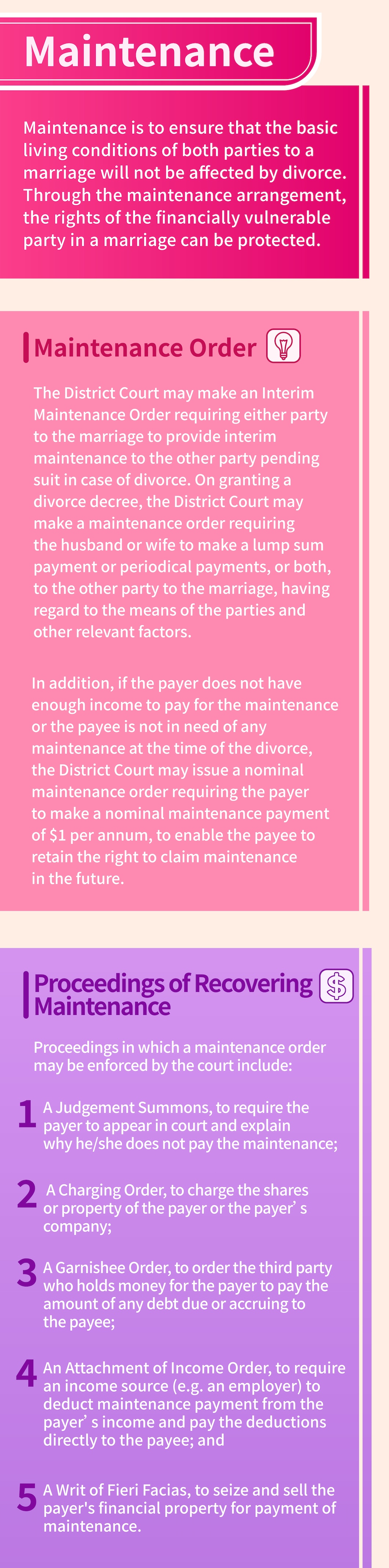
The Government is committed to enhancing the effectiveness for collecting maintenance payments and enforcing maintenance orders. Over the years, a series of improvement measures have been implemented to help divorcees recover maintenance payments. The measures that have been implemented include:
- Relaxing the conditions for the court to issue an Attachment of Income Order (“AIO”) to allow more flexibility in the ordering process.
- The Attachment of Income Orders (Amendment) Ordinance 2001 came into effect on 25 January 2002 with the following relaxations:
- when a maintenance order has been made by the court and the maintenance payer has income which is liable to be attached, the court may make an AIO if -
- the court is satisfied that the maintenance payer has failed to make payment in accordance with the maintenance order without reasonable excuse;
- the court has reasonable grounds to believe that the maintenance payer will not make full and punctual payment in accordance with the maintenance order; or
- both the maintenance payer and the payee agree to the issue of an AIO;
- an AIO can be made at the same hearing at which a maintenance order is made or varied by the court (the court can make an AIO on its own motion or on the application of the maintenance payer, payee or both); and
- the court may dispense with or relax the procedures, or shorten the periods, prescribed in the Attachment of Income Order Rules.
- when a maintenance order has been made by the court and the maintenance payer has income which is liable to be attached, the court may make an AIO if -
- The AIO (Application to Government and Miscellaneous Amendments) Bill 2007 came into effect on 15 June 2007 and the court may make AIO in respect of all income sources.
- The Attachment of Income Orders (Amendment) Ordinance 2001 came into effect on 25 January 2002 with the following relaxations:
- Imposition of interest or surcharge on defaulting maintenance payers
- The Interest and Surcharge on Arrears of Maintenance Ordinance 2003 came into effect on 1 May 2005. Under the Ordinance, a maintenance payee is entitled to interest on arrears of maintenance automatically at the judgement rate or at a rate granted by the court. If the payee considers that the payer has persistently failed to pay maintenance without reasonable excuse, he/she may apply to the court for a surcharge on the arrears of maintenance. The court may order the payer to pay a surcharge of up to 100 % of the amount in arrears.
- For more detailed information about the interest and surcharge on arrears of maintenance, you may visit the thematic website.
- To request Government departments to disclose the addresses of maintenance payers
- If the legal professional requests and is able to provide sufficient information, designated Government departments (i.e. the Immigration Department, the Transport Department and the Housing Department) may disclose the address of the maintenance payer, so as to enable legal action to be taken against the payer to recover arrears in maintenance payments.
- Increase the maximum amount that can be exempted from the Director of Legal Aid's first charge (including the monthly maintenance payment for spouses and cases of severe hardship)
- The Government has adjusted upwards the amount of monthly (spousal) maintenance exemption from the Director of Legal Aid's first charge from $4,800 in 1997 to $9,370 in 2023, and the maximum amount that can be waived in serious hardship cases from $57,400 in 1997 to $112,120 in 2023. This measure provides relief to legal aid recipients who may suffer hardship as a result of the deduction of legal expenses from their recovered property.
- Streamlining the referral procedures for Comprehensive Social Security Assistance (CSSA) recipients to apply for legal aid to recover maintenance arrears
- At present, the Social Welfare Department (SWD) refers CSSA recipients in need to the Legal Aid Department (LAD) to apply for legal aid to recover maintenance payments. LAD will provide legal aid to eligible applicants who pass both the means test and the merits test, to help them recover maintenance arrears.
- LAD and SWD have strengthened co-operation since 2018 to streamline the existing case referral procedures to expedite the processing of applications.
- The LAD has appointed a liaison officer to handle referrals's enquiry on legal aid for the recovery of maintenance payments.
- Launching publicity and education programmes
- The Government launched publicity and education programmes, including the Community Involvement Projects on Maintenance (CIPM), to enhance the public's understanding of the obligations of maintenance payers, the rights of maintenance payees and the services available to them if they fail to collect maintenance payments.
The Mainland Judgments in Matrimonial and Family Cases (Reciprocal Recognition and Enforcement) Ordinance
On 15 February 2022, the Mainland Judgments in Matrimonial and Family Cases (Reciprocal Recognition and Enforcement) Ordinance (Cap. 639) (“the Ordinance”) came into effect. The Ordinance offers better safeguards to the interest of parties of cross-border marriages, as well as their families and children. This also minimses the need for re-litigation of the same dispute in courts of both Hong Kong and the Mainland, which saves time and costs and reduces emotional distress of the parties.
According to the Ordinance, applications may be made in relation to one or more specified orders in Mainland judgments given in matrimonial or family cases if the judgments are effective in the Mainland.
Specified orders are categorised into 3 types:
- status-related orders (such as orders granting divorce, etc.)
- care-related orders (such as orders in relation to custody, right of access, etc.)
- maintenance-related orders (such as orders in relation to maintenance of a person under the age of 18 years, spousal maintenance, division of property between parties to a marriage, etc.)

For more detailed information about the Ordinance, you may visit the thematic website of the Department of Justice on the Mainland Judgements in Matrimonial and Family Cases (Reciprocal Recognition and Enforcement) Ordinance (Cap. 639) and publication
Source of information: Department of Justice